Wednesday, 21 September 2011

One of the most obscure questions in history


Fashion's ability to anticipate how the future will look is surely one of the things that makes it most magical. That 'feeling' you get, (and I cant be any more specific than that), when you see an outfit that is just fresh, new, exciting and 'on the pulse', is amazing. For example, I have recently been thinking a lot about green and silver combinations, so was thrilled to see the appearance of this dress by Christopher Kane for S/S 12. It was also eerily similar to some fabric I picked up at a market in Kyoto during the summer.

How do we explain these coincidences or rationalise this 'feeling' we get when designers seem to correctly anticipate a mood two seasons ahead. As cultural historian Eric Hobsbawm said,
'Why brilliant fashion designers, a notoriously non-analytic breed, sometimes succeed in anticipating the shape of things to come better than professional predictors, remains one of the most obscure questions in history and, for the historian of culture, one of the most central'. I was always quite pleased to read this acknowledgement from Hobsbawm of the significance of fashion theory as a method of reading culture, except that I found comment 'a notoriously non-analytic breed' rather derogatory. Then I watched this clip on the guardian website of Christopher Kane explaining his collection to Simon Chilvers:


Ok, so maybe the man was tired, and some of what he said was really interesting (I loved his comments about a look based on 'the girl you hated at school', which has been a disturbingly common trend for S/S12), but he made much of his references and inspiration for the collection appear to be totally random and coincidental. Is it all down to a short attention span and a low boredom threshold, as he would suggest? Whatever the reason, this collection was one of the most interesting and inspiring I have seen for a long time. He might not know how he does it, but Christopher Kane is a genius and yes, he can predict the future.

Tuesday, 20 September 2011

Tweet-walk


So this year's London Fashion Week has taken an interesting twist at the hands of Christopher Bailey, which wouldn't be the first time.Last season, Bailey used his fashion house Burberry to subvert the concept of exclusivity and the catwalk show by projecting the A/W show on a huge screen at the tourist-trap centre of London's Piccadilly. This time, he appeared to push the boundaries even further by live-tweeting each look from S/S 2012 before (gasp!) his privileged audience got to see them on the catwalk.

All of this would provide good reason to think of Bailey as a man single-handedly re-inventing the entire concept of the fashion show, as many have done. The first couture shows in London by Lady Duff Gordon in Hanover Square in the early 19th century set the tone for the catwalk show as utterly exclusive and elitist. In the hundred years since then, they have changed very little. (See Tom Ford's bizarre ban on photography at his hyper-exclusive showing this season). These live-tweets, in stark contrast, suggest that high-fashion is not something for just the few to enjoy. How then does this new seemingly accessible presentation change our relationship with fashion as consumers? How has it altered the distance, which has always been such a crucial element of our desire for fashion, between creator and buyer?

Bailey has said himself that he is keen to push Burberry into the heart of the digital media revolution, and so far, he seems to be on a solo-mission in that direction. This does produce some very interesting dichotomies which i think he is really brave to explore: the contrast between textile craft techniques at the heart of the Burberry aesthetic contrasted with the modern, digitalised method of presentation. However, part of me also wonders if it might be rather naive to view this 'live-tweeting' as an entirely democratising, 'fashion-is-for-all' movement. Rather conversely, could it be that by shifting Burberry onto a digital platform like twitter, a place of alternative reality, he is creating fashion imagery in a place non of us can really get to. Fleeting, momentary and utterly intangible; is there anything less distant than the world of Twitter? If we think of it that way, its a medium perfectly suited to fashion. Perhaps Tom Ford should re-consider his strategy.

Wednesday, 31 August 2011

Hug a Hoody


Hug a Hoody

This summer the image of the ‘hoody’ became a menacing symbol of youth culture turned violent.

Of all the political and academic experts now dominating our media offering explanations for the causes of this month’s dreadful violence, few will have been looking to the catwalks for evidence. And yet, a glance to the shows of Spring/Summer 2011 shows an eery presence of the hoody on the catwalk. It’s not just disillusioned youth hiding behind a hoody; Celine, Lacoste, Diane Von Furstenburg all made a feature of the hooded shirt, sweater and jacket. Just like on the streets, designers used the image of the hoody to project an attitude of independence, rebellion and of toughness. Perhaps more interestingly however, the soft hues and comforting cottons of these hoodies also portrayed the garment as a source of solace, comfort and protection in an increasingly challenging environment.

We might do well to take note from this season’s catwalks. Perhaps the hoody can act as a metaphor to help us realise a common enemy. The hoody itself is not the problem (as Celine’s delectable example proves): it’s whatever we are using it to hide from that we need to confront.

Wednesday, 1 December 2010

Clothes to protest in


" Student protestors are ugly and badly dressed" - Tory Councillor Keith Mitchell

An odd, but extremely revealing comment. Protests offend Mitchell's aesthetic taste. He finds it ugly and in poor judgement.

And yet, I think Mitchell's comments are pertinent on two levels.

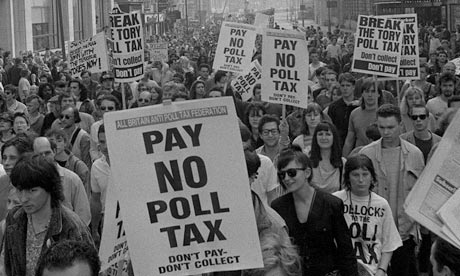
Firstly, the appearance of a group of people is important in communicating a cohesive and can amplify a political message. The above image, taken at the anti-Poll tax march is evidence of this, with Katherine Hamnett's slogan t-shirts portraying a distinctive and vocal image. Riot police are known to be chosen for their height and adorned with big helmets and a huge uniform to make them more intimidating. In the 1980s, the working class developed an aesthetic that would stand up to this brutish image- in the form of Doc Martens.

Secondly, Mitchell's comments are a reminder that in protest, the body is our last resort. Hunger strikers of course take this to the extreme. In Hunger, which is an extremely brave and powerful film about of the protest of Irish Republican Bobby Sands in the Maze prison in Ireland is a fascinating testimony to this. In one particular scene, the prison guards make the prisoners wear clown costumes to take the last piece of their dignity as they protested in the prison.

We should recognise therefore the use of clothing in promoting our cause. If, as the media is keen to suggest, the next few years will be seeing a surge of protest in response to the offensive budget cuts, shouldn't we be thinking of how to make our message most effectively seen?

Friday, 12 November 2010

Beauty


Aung San Suu Kyi Burma's pro-democracy leader is to be released after 15 years under house arrest. Her personal photographs, which you can see on the guardian website, embody all that I value about feminine beauty.

Monday, 8 November 2010

A Woman's Glove


" I also remember the apparently joccular proposition once made in my presence to a lady, asking that she present to the Centrale Surrealiste one of the remarkable sky-blue gloves she was carrying on a visit to us at this 'Centrale'...I dont know what there can have been, at that moment, so terribly, so marvellously decisive for me in the thought of that glove leaving that hand forever''.

- Andre Breton, Nadja, (1928)

Reading Nadja, Breton's surrealist love story, is a bit like what I imagine it might be like to sit in the front row of an Alexander McQueen show. Breton dazzles the reader with a flash-photography trail through Paris, stopping to zoom in on interesting and alluring objects, many of which are items of clothing. Like a McQueen show, the experience might be somewhat unsettling. This is because in both cases the images on show are bizarre and utterly familiar at the same time- they achieve a level of romance and beauty which is neither imaginary nor real. Most of all, Breton obsesses over Nadja's, gloves. Whether sky blue or bronze, he 'can never resist picking them up, always astonished at its weight'. I have been shopping for gloves recently and I have to agree that there is something rather rigid and freakish about the sight of an empty woman's glove in a clothes shop. There is something imposing about the intended fragility and dainty-ness of the fingered leather glove, like this one which Breton places includes in the book to illustrate his fixation:

Saturday, 19 June 2010

More generous than opulence


Like every obstacle in the way of possessing something...poverty, more generous than opulence, gives women far more than the clothes they cannot afford to buy: the desire for clothes, which creates a genuine, detailed, thorough knowledge of them.
- Marcel Proust

Having now sunk to very low levels of poverty, not only can I not afford the clothes in magazines, but I can no longer afford the magazines themselves. I was thinking about this today as I lingered indulgently in Magma, Manchester, soaking up a batch of amazing new fash editorial (nude palette beach shoot in Fantastic Man is AMAZING, by the way), without purchasing anything. This is not a problem. Really. I still left the shop feeling a little exhausted, drained, but utterly cathartic and inspired. My head was swimming with ideas about fashion.
Similarly, clothes have always meant so much more to me in my imagination than they have on a hanger. I dream about clothes that I not only cannot afford, but that don't even exist and that I know I will never have. I love that Proust recognises this emotional aspect of clothing beyond the material. One of my favourite things to do before I go to sleep is to think of colour, shape and style combinations in my head. The one dress I find myself looking for and dreaming of most is this alexander mcqueen on kate moss. I will never wear or even see a dress like this, but I can dream of it and that is no less special a thing.