Wednesday, 31 August 2011

Hug a Hoody


Hug a Hoody

This summer the image of the ‘hoody’ became a menacing symbol of youth culture turned violent.

Of all the political and academic experts now dominating our media offering explanations for the causes of this month’s dreadful violence, few will have been looking to the catwalks for evidence. And yet, a glance to the shows of Spring/Summer 2011 shows an eery presence of the hoody on the catwalk. It’s not just disillusioned youth hiding behind a hoody; Celine, Lacoste, Diane Von Furstenburg all made a feature of the hooded shirt, sweater and jacket. Just like on the streets, designers used the image of the hoody to project an attitude of independence, rebellion and of toughness. Perhaps more interestingly however, the soft hues and comforting cottons of these hoodies also portrayed the garment as a source of solace, comfort and protection in an increasingly challenging environment.

We might do well to take note from this season’s catwalks. Perhaps the hoody can act as a metaphor to help us realise a common enemy. The hoody itself is not the problem (as Celine’s delectable example proves): it’s whatever we are using it to hide from that we need to confront.

Wednesday, 1 December 2010

Clothes to protest in


" Student protestors are ugly and badly dressed" - Tory Councillor Keith Mitchell

An odd, but extremely revealing comment. Protests offend Mitchell's aesthetic taste. He finds it ugly and in poor judgement.

And yet, I think Mitchell's comments are pertinent on two levels.

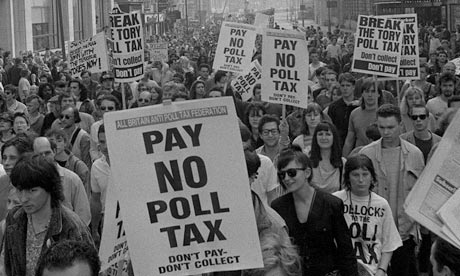
Firstly, the appearance of a group of people is important in communicating a cohesive and can amplify a political message. The above image, taken at the anti-Poll tax march is evidence of this, with Katherine Hamnett's slogan t-shirts portraying a distinctive and vocal image. Riot police are known to be chosen for their height and adorned with big helmets and a huge uniform to make them more intimidating. In the 1980s, the working class developed an aesthetic that would stand up to this brutish image- in the form of Doc Martens.

Secondly, Mitchell's comments are a reminder that in protest, the body is our last resort. Hunger strikers of course take this to the extreme. In Hunger, which is an extremely brave and powerful film about of the protest of Irish Republican Bobby Sands in the Maze prison in Ireland is a fascinating testimony to this. In one particular scene, the prison guards make the prisoners wear clown costumes to take the last piece of their dignity as they protested in the prison.

We should recognise therefore the use of clothing in promoting our cause. If, as the media is keen to suggest, the next few years will be seeing a surge of protest in response to the offensive budget cuts, shouldn't we be thinking of how to make our message most effectively seen?

Friday, 12 November 2010

Beauty


Aung San Suu Kyi Burma's pro-democracy leader is to be released after 15 years under house arrest. Her personal photographs, which you can see on the guardian website, embody all that I value about feminine beauty.

Monday, 8 November 2010

A Woman's Glove


" I also remember the apparently joccular proposition once made in my presence to a lady, asking that she present to the Centrale Surrealiste one of the remarkable sky-blue gloves she was carrying on a visit to us at this 'Centrale'...I dont know what there can have been, at that moment, so terribly, so marvellously decisive for me in the thought of that glove leaving that hand forever''.

- Andre Breton, Nadja, (1928)

Reading Nadja, Breton's surrealist love story, is a bit like what I imagine it might be like to sit in the front row of an Alexander McQueen show. Breton dazzles the reader with a flash-photography trail through Paris, stopping to zoom in on interesting and alluring objects, many of which are items of clothing. Like a McQueen show, the experience might be somewhat unsettling. This is because in both cases the images on show are bizarre and utterly familiar at the same time- they achieve a level of romance and beauty which is neither imaginary nor real. Most of all, Breton obsesses over Nadja's, gloves. Whether sky blue or bronze, he 'can never resist picking them up, always astonished at its weight'. I have been shopping for gloves recently and I have to agree that there is something rather rigid and freakish about the sight of an empty woman's glove in a clothes shop. There is something imposing about the intended fragility and dainty-ness of the fingered leather glove, like this one which Breton places includes in the book to illustrate his fixation:

Saturday, 19 June 2010

More generous than opulence


Like every obstacle in the way of possessing something...poverty, more generous than opulence, gives women far more than the clothes they cannot afford to buy: the desire for clothes, which creates a genuine, detailed, thorough knowledge of them.
- Marcel Proust

Having now sunk to very low levels of poverty, not only can I not afford the clothes in magazines, but I can no longer afford the magazines themselves. I was thinking about this today as I lingered indulgently in Magma, Manchester, soaking up a batch of amazing new fash editorial (nude palette beach shoot in Fantastic Man is AMAZING, by the way), without purchasing anything. This is not a problem. Really. I still left the shop feeling a little exhausted, drained, but utterly cathartic and inspired. My head was swimming with ideas about fashion.
Similarly, clothes have always meant so much more to me in my imagination than they have on a hanger. I dream about clothes that I not only cannot afford, but that don't even exist and that I know I will never have. I love that Proust recognises this emotional aspect of clothing beyond the material. One of my favourite things to do before I go to sleep is to think of colour, shape and style combinations in my head. The one dress I find myself looking for and dreaming of most is this alexander mcqueen on kate moss. I will never wear or even see a dress like this, but I can dream of it and that is no less special a thing.

Tuesday, 2 March 2010

Exorcising spectres

Its been quite exciting for me to notice that one of the major trends to emerge from this season's fashion weeks has been the confrontation between fashion and feminism on the catwalk. Fashion for a long time has overlooked its problems and gone through each year pretending they dont exist. This season, things got more confrontational. Two long-haunting spectres of fashion have been raised up to walk on the catwalk and incite debate among the fashion reading public: the exploitation of female models and the promotion of gratuituous sexuality.


It happened first in London , with Mark Fast, who put a full stop at the end of his admittance that there is a problem with the way in which the fashion industry encourages a perfectly skinny image by using so called 'plus-size' models in his fashion show. His collection was bold and creative and in presenting a viable alternative- a real image of a fashion world without unhealthy models and unhealthy images, he brought the industry a small, but significant step closer to progress. If fat is a feminist issue, then Fast should be applauded for efforts to exorcise this ghost from the fashion industry.


Another haunting spectre, at least in feminism terms, has been the representation of the female figure in a gratutiously sexual display. This always happened at Milan. It was always gorgeous and totally self-aware, but it also presented fashion as a means of satisfying masculine desire. Success was achieved through curves- all tits and ass. This debate was paraded up and down the catwalk of Prada's A/W collection in fantastically parodic fashion. The one woman you dont expect to base a collection on tits and ass is Muccia Prada, but that was just the point.

The very basis of the collection was on 'how the idea of sexy is becoming a narrower one'and 'about the cliches that woman can't seem to give up'. Surrounded by a sea of fashion designers who have been obsessed for years with sexuality, Prada suggested, through these clothes, that the final barrier could be broached between feminism and fashion if woman abandoned their fixation with clothes as a means of satisfying men.

By exorcising these demons in a totally confrontational and honest way, Prada and Fast both signalled the possibility of abandoning old ideologies which render feminism incompatible with fashion and seeking new avenues, and new figures, through which female empowerment can be sought.

Sunday, 28 February 2010

Why Rouge?


Yesterday I went shopping to buy something red. I didn't quite know what the specific item had to be, but I knew exactly the colour that I wanted; a burnt orange-y vibrant red and I knew that whatever this item of clothing would be (a shirt/ dress/bag/belt?), it would inject some life into my wardrobe. I also had the feeling that a slash of red would be a playful and rebellious challenge to the current 'sorbet' and pastel colours which have dominated my purchases of late. I didnt find anything, perhaps precisely because of the high-street's only selling spring's sorbet shades. Anyway, it didnt matter, but it got me thinking about colour. What is it that makes a certain colour feel 'right' at a certain time of year or for a certain mood? My current obsession with red might have something to do with the recent a/w 10 shows, where splashes of red really resonated on the catwalk, but even if this is the case- who are the people who decide which colours will be 'on trend' and how do these colour choices dictate how we shop and dress from season to season?

A brief foray into the history of colour made me a bit panicky about how little I understand about the whole weird process of how we conceptualise and view colour subjectively. (Can anyone explain Goethe's colour theory to me please?!) I had never even considered analysing sartorial codes and fashion from this scientific perspective, but it surely holds some promise? Pity I am I dont have any scientific grounding to explore this idea in a meaningful way.

On more solid ground, (for me at least), an article by Shinobu Majima in the Textile History journal, stated that the International Commission for Fashion and Textile Colors was established in Paris in 1963. A committee was held biannually before each fashion season. The same year, Pantone started to sell a book of standardised colours. It used computers to sort and numerically match coded colour data and to print out chemical formulae for reproducing the hues. I wonder if this development had more than a commercial results? Did it mark a turning point in our consumption of colour and the way in which it became more integrated into everyday living? Undoubtedly. Has anyone investigated the relationship between 'fashionable colours' (eg. browns and oranges in the 70s) and politics/ social system? Or indeed our subjective and internal relationship with colour in terms of gender, especially in the way in which we dress ourselves? I would be fascinated to know.

Anyway, my quest for rouge continues.